In development
CapyBrain
A curious guide to people and places.
A research prototype exploring how environmental conditions relate to residents’ experiences.
Meet your capybara guide

Notice the places we move through every day.
Research approach
We aim to connect environmental readings with residents’ feedback. Survey consent, privacy, sampling, and validation are still being developed.
Environmental data
Environmental and geographic context
Planned surveys
Residents’ experiences
Consent and privacy to establish
Research and validation
Methods and limits to establish
Topics under consideration
Possible topics, not validated neighborhood scores.
Inside the prototype
Interface concepts for exploring places and sharing experiences.
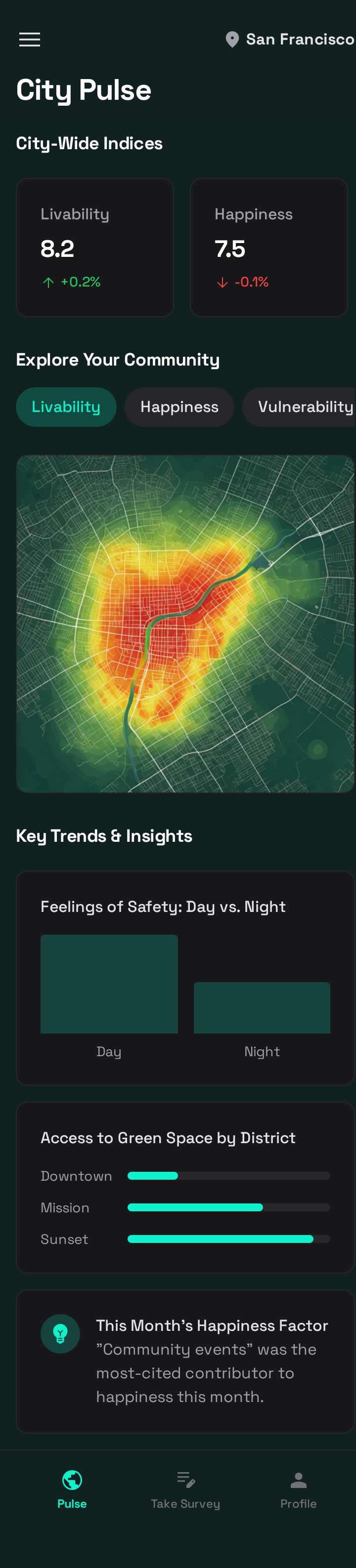
City-Wide Trends Dashboard
View full screenshotLive experiment
From a London street to predicted brain activity
Street images around Borough Market, London, processed with Meta’s TRIBE v2 model to visualize predicted brain activity.
Loading interactive demo…
Select a marker to explore a prediction. This model does not measure anyone’s brain activity, hormones, emotions, or health, or establish how a place makes people feel.
Source code: CapyBrain research repository.
Methods and licenses
3D viewport interaction inspired by Meta's TRIBE v2 demo. Encoder weights and reference code from facebookresearch/tribev2, licensed CC-BY-NC-4.0 (non-commercial).
Street imagery from Mapillary contributors, CC-BY-SA. Cortical parcels from the HCP MMP1 atlas (Glasser et al., 2016).
Our code and derived data are licensed CC-BY-4.0. See LICENSE. Outputs of TRIBE v2 inherit Meta's non-commercial terms, treat them accordingly.
Explore the data
Explore environmental context on our live globe.